Data Shows No Direct Link Between Bused Migrants and Rising Crime in Major Cities, Researcher Says
A Marshall Project analysis of crime figures from four cities that received large numbers of bused migrants found no clear connection between their arrival and crime increases.
By Juan Gonzalez ·
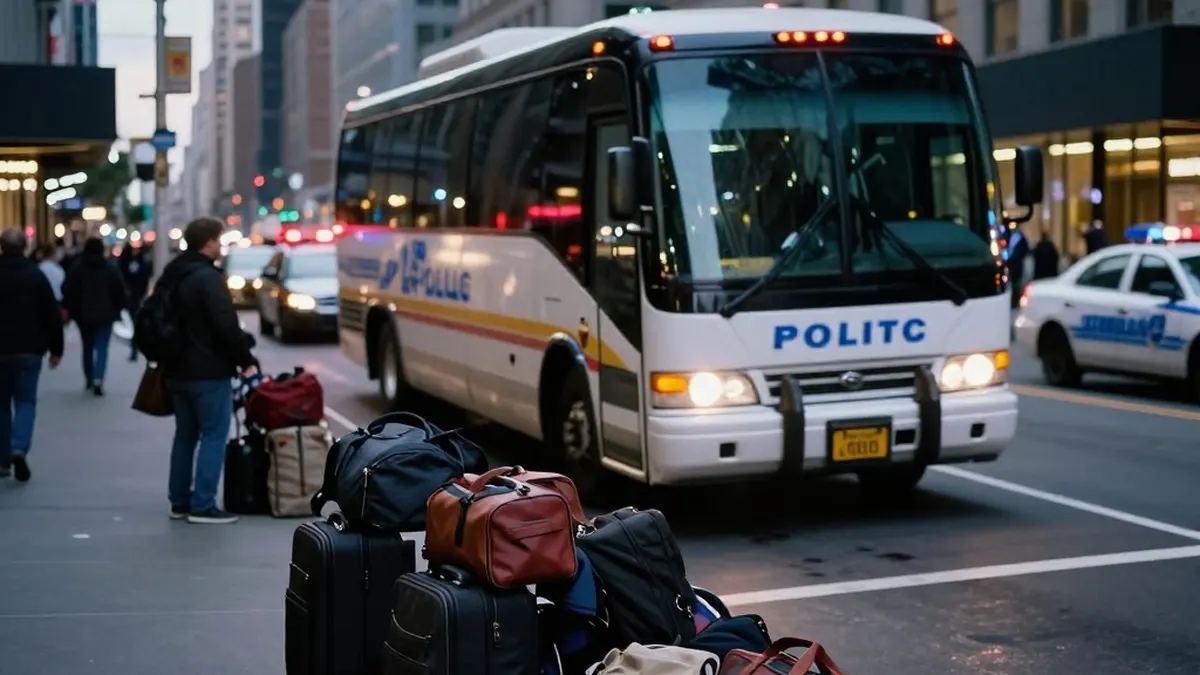
Texas Gov. Greg Abbott has said his state has transported more than 100,000 migrants to cities around the country, which he describes as sanctuary cities. The arrivals have strained aid networks in many northern and western cities that were not set up to handle them, and they have also fueled fears of an approaching crime wave.
Those concerns have been sharpened by recent events in New York City. A video of a brawl between migrants and NYPD officers in Times Square drew wide attention, and Mayor Eric Adams joined a police raid targeting an alleged robbery ring. To test whether the fears hold up, Weihua Li, a data reporter for the Marshall Project, examined the available crime figures. She discussed her findings in an interview with KJZZ's Lauren Gilger.
Li said her team relied on data compiled by the Council on Criminal Justice, a think tank that collects crime statistics from more than three dozen cities nationwide. The analysis focused on New York, Chicago, Denver and Washington, D.C. According to the Texas governor's office, each of those cities has received more than 10,000 migrants through the state's busing programs. Li noted that Texas is not the only state to have bused migrants; Arizona has also done so.
After plotting each city's crime trends and marking when migrants began to arrive, Li said the team found no direct link between the arrivals and any rise in crime in cities such as New York and Chicago. Robberies and shoplifting did increase, she said, but those upward trends began in 2021, well before migrants were bused into those cities.
Li said the broader picture reflects a return to pre-pandemic patterns, though the details depend on the type of crime. Murders rose about 30% nationally during the pandemic, then gradually declined, and by 2022 were close to earlier levels. Shoplifting dropped sharply when people stayed home and stores closed, then climbed steadily afterward. Shoplifting was higher in 2023 than in 2022, she said, but compared with 2019 conditions appear to be normalizing.
As for why the public narrative departs from the numbers, Li said perceptions of crime and actual crime have long diverged. Violent crime fell consistently for roughly two decades before the pandemic, yet polls and surveys regularly showed that a large majority of Americans believed their communities were becoming more dangerous.
She added that some crimes are genuinely rising, motor vehicle theft among them, which has seen a dramatic increase. With people already inclined to believe crime is climbing, she said, news reports about individual migrants who committed offenses make it easy to link an entire community to a perceived rise in crime.
Source: KJZZ